Protecting Your Practice and Building Your Future
Why no architect should have to navigate the business of practice alone
There are times during a hectic workday that I reflect on how our profession has changed over the course of my career. When I think back to why I wanted to become an architect, I remember an education that prepared me to become a designer and a critical thinker. What it didn’t prepare me for was running a business.
As our careers progress, many of us spend less time doing the creative work that first drew us to architecture and more time navigating the realities of practice. We negotiate contracts, respond to construction issues, market our firms, manage risk, plan for retirement, oversee technology, and somehow find time to practice. Most of us were never formally taught how to do any of that.
Years ago, I had the honor of becoming an owner in a large multi-discipline firm that was started in 1894. I will always remember the 85-year-old son of the founder telling me how he remembered the days when “a man’s word and handshake” was all you needed to take on a project. This was shared with me after I commented how one of our most recent projects for a state client had a 100-page contract for us to execute. The profession – and the risks we manage every day – have changed dramatically!
I’ve owned a small firm and later became a partner in a much larger one. What I eventually realized was that the challenges are remarkably similar. The difference isn’t the problems - it’s the scale. Whether you lead a firm of fifty people or work as a sole practitioner, those responsibilities still must be managed. In a small firm, that responsibility often falls to one person: you.
Today, the latest data tells us that of the over 19,000 architecture firms in the US, 75% have fewer than 10 employees.* This signals to me that today’s firm leaders are faced with making critical decisions on an ever-growing list of tasks that are becoming more complex every day. This reality has reinforced something I’ve come to believe over the years: none of us should have to navigate those challenges alone.
Having known SARA Executive Director, Fabiyan Pembelski for several years, and more recently having the opportunity to meet SARA President Kevin Regalado, FSARA, I have been impressed by the organization’s mission of “Architect helping Architect”! That philosophy resonates with me. Throughout my career, I have made it a personal goal of helping others become successful by sharing lessons learned, mistakes to avoid, and valuable resources that can help architects navigate the challenges of practice.
One of the accomplishments I’m most proud of is helping co-found the NCARB Leadership Institute, where I continue to enjoy teaching architects the leadership skills that strengthen both individuals and the profession. More recently, I’ve become a strong supporter of the free resources and educational opportunities offered by the AIA Trust because they reflect that same commitment to helping architects succeed.
If you’ve never explored the AIA Trust because you assumed it was simply part of AIA, you’re not alone. The Trust is an independent nonprofit established in 1952, with a mission of helping architects with practical education, trusted resources, and risk management solutions. Similar to the goals and spirit of SARA, the Trust is committed to “Protecting your practice and building your future”.
I encourage you not to let three familiar letters keep you from discovering another resource created to support architects. Consider the AIA Trust another partner as you grow your practice and your career and I think you will be surprised by the depth of its resources. Many AIA Trust articles, educational resources, webinars, newsletters, the A/E Attorney Database, and the Professional Liability Insurance (PLI) Database are available to architects regardless of AIA membership. This and much more can be found at theaiatrust.com.
As a former NCARB President - and the first Hispanic to hold that position in the 103- year history of the organization - I often spoke to many audiences on the importance of working together to influence, change, and improve our noble profession for the benefit of those to follow. I see organizations like SARA and the AIA Trust as part of that same effort—sharing knowledge, developing leaders, and providing the practical resources architects need to build successful practices and strengthen our profession for those who follow.
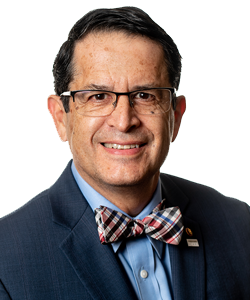
Alfred Vidaurri, Jr.,
NCARB, AICP, FAIA, AIA Trust Trustee