Frank Furness and Enduring Questions of American Architecture
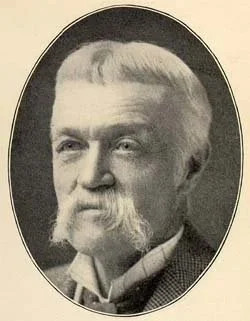
Frank Furness portrait Frank Furness (1839–1912), architect, Civil War veteran, and the only architect awarded the Congressional Medal of Honor. Public domain. Source: Wikimedia Commons.
By Maria Lowndes Sevely, ASSOC. SARA
Two-hundred-fifty years after the Declaration of Independence, American architects are still working out what it means to build in this country. We continue to balance respect for precedent with the desire to respond to our own time. These tensions are not new, but they remain unresolved.
On this anniversary, one figure stands out whose life and work speak directly to these ongoing questions, even if he rarely appears in broader public discussions of American architecture. Frank Heyling Furness (1839–1912) was an architect, a Civil War veteran, and the only architect ever awarded the Congressional Medal of Honor. After the war, he dropped his middle name and was known simply as Frank Furness. His buildings can be difficult to love and are not always easy to understand. That difficulty is part of what makes them worth attention.
This article launches Architect Perspectives, a new series from the Society of American Registered Architects. While most future pieces will feature views from SARA members, Furness offers a useful starting point. His work and his life resist easy categories, and they invite us to consider what it means to practice architecture in America without requiring consensus.
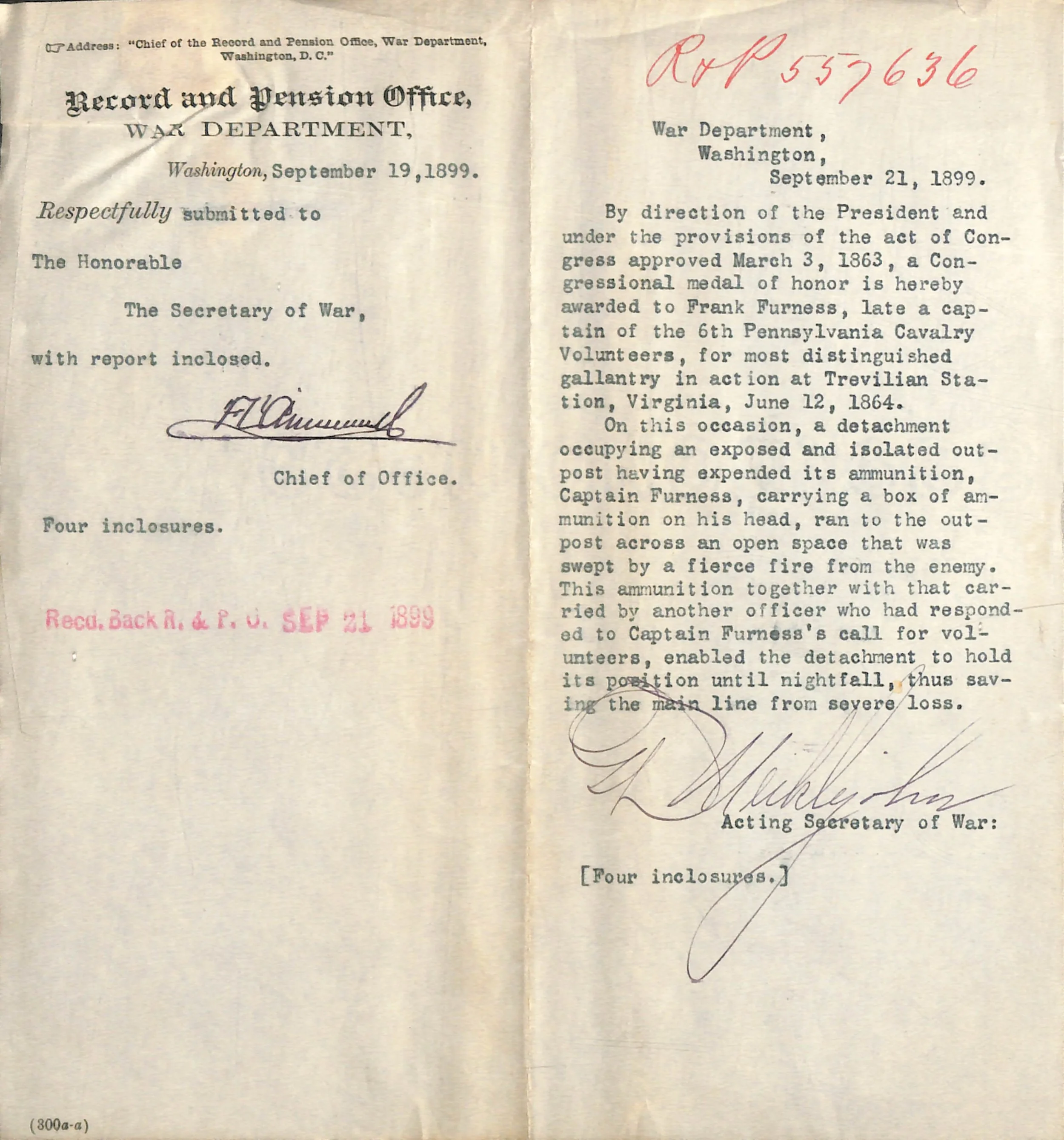
1899 War Department Medal of Honor award letter Record of Award of the Congressional Medal of Honor for Captain Frank Furness, 6th Pennsylvania Cavalry, June 12, 1864 (Trevilian Station, Virginia). National Archives and Records Administration (NARA), Record Group 94, Entry 496, Military Record File of Frank Furness. Public record.
The War Department letter of September 21, 1899, states that on June 12, 1864, at Trevilian Station, Virginia, “Captain Furness, carrying a box of ammunition on his head, ran to the outpost across an open space that was swept by a fierce fire from the enemy.” As an officer, he had called for volunteers; only one other officer responded. He was twenty-four years old. No one ordered him to do it. He saw a need and acted.
Furness rarely spoke about his military service until much later in life and never used it to advance his career. That restraint is striking. He returned from the war, as so many did, a changed man. Whether that experience shaped the character of his architecture is impossible to know with certainty. What is clear is that his buildings possess a muscularity and independence that set them apart from most work of his time.
HIS FATHER’S FRIENDSHIP WITH EMERSON & HIS PHILOSOPHICAL FOUNDATION
Furness was also shaped by his family. His father, Rev. William Henry Furness, was Philadelphia’s leading Unitarian minister and a close friend of Ralph Waldo Emerson. His sermons emphasized moral courage and the necessity of following conscience wherever it led. Furness’s brother, Horace Howard Furness, became the country’s foremost Shakespeare scholar. The household valued independent thought and treated conformity with suspicion.
James F. O’Gorman, who wrote the foundational monograph on Furness, argued that his distinctive work grew not from a lack of training, but from a stubborn independence of mind. One contemporary observer quoted by O’Gorman described Furness’s “oddities” as “the rebellion of a freedom-loving soul that refused to be bound by rules.”
THE QUESTION OF AMERICANISM
Early American architecture looked to Classical models for stability and legitimacy. Many still regard the Neoclassical period as the only truly “American” architecture. Yet by the time Furness began practicing, the country had passed through the Civil War. It had been tested and fractured. A changed nation required a changed architecture.
Furness spent his entire career in Philadelphia, the city most closely tied to the nation’s founding. His buildings do not fit neatly into any single historical style. They draw on Gothic and Romanesque elements without being strictly either. They are neither straightforwardly Victorian nor Classical, and they remain too rooted in precedent to be considered proto-Modern. They are hybrids— experiments that reflect a country still in the process of defining itself.
Lewis Mumford later called Furness’s Provident Life & Trust Company “nothing less than a second Declaration of Independence.”
Whether or not one agrees with the assessment, Furness’s work raises a persistent question: What does American architecture look like when it absorbs the complexities of the nation’s actual history rather than idealizing its origins?
BUILDINGS THAT ARE STILL DISTINCTIVE
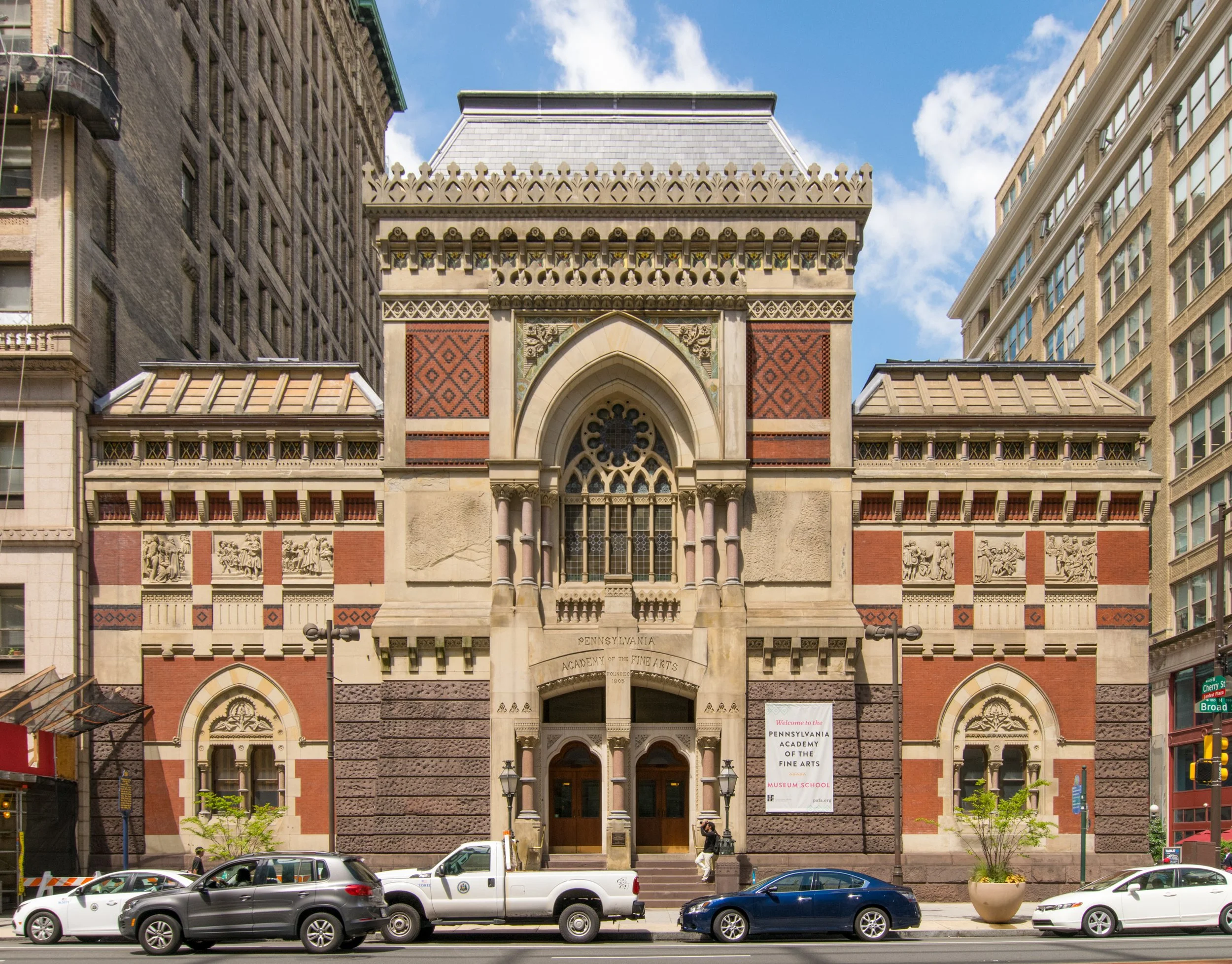
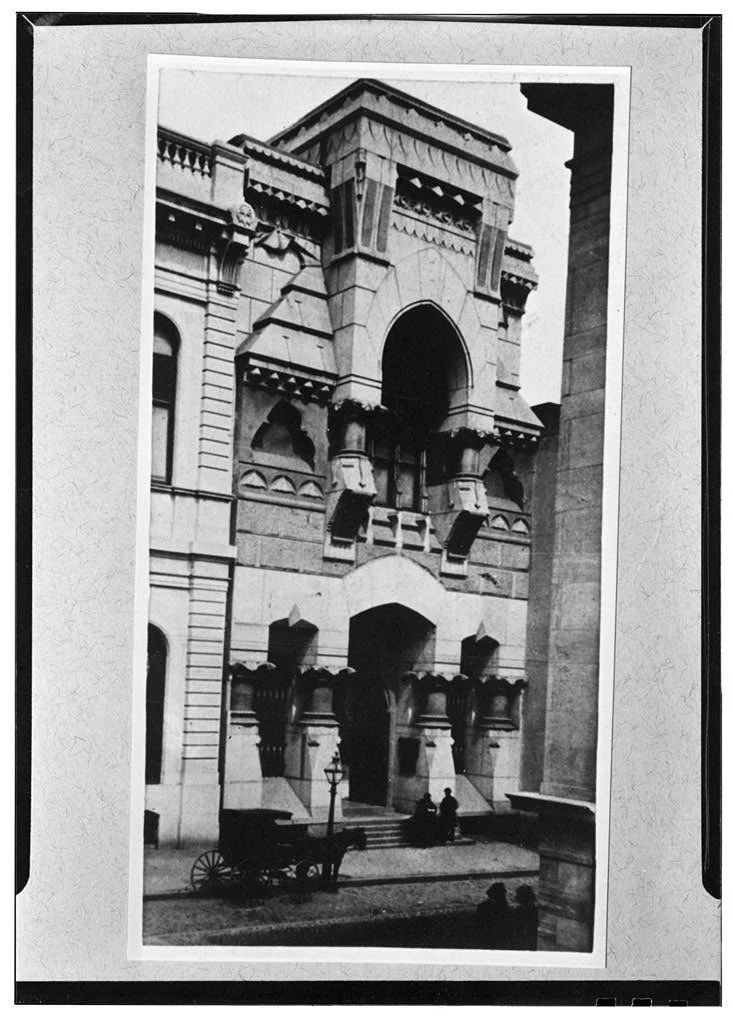
Consider the Pennsylvania Academy of the Fine Arts (1871–76). Its facade layers historical references with unusual density: a Gothic window and arch above the entrance, Classical panels supporting the roofs of the wings, and heavy rustication that gives the building the presence of a fortress for art. It is exuberant, asymmetrical, and structurally expressive. Some find it magnificent. Others find it bewildering. Few find it forgettable.
Consider the Provident Life & Trust Company (1876–79). Built of brick and iron, it has a heavy, almost primitive massiveness. It does not simply secure money — it makes it feel entombed. The ornament is correspondingly rugged and geometric, and the windows read more like deeply recessed viewports than conventional openings. The building feels both ancient and strangely modern at once.
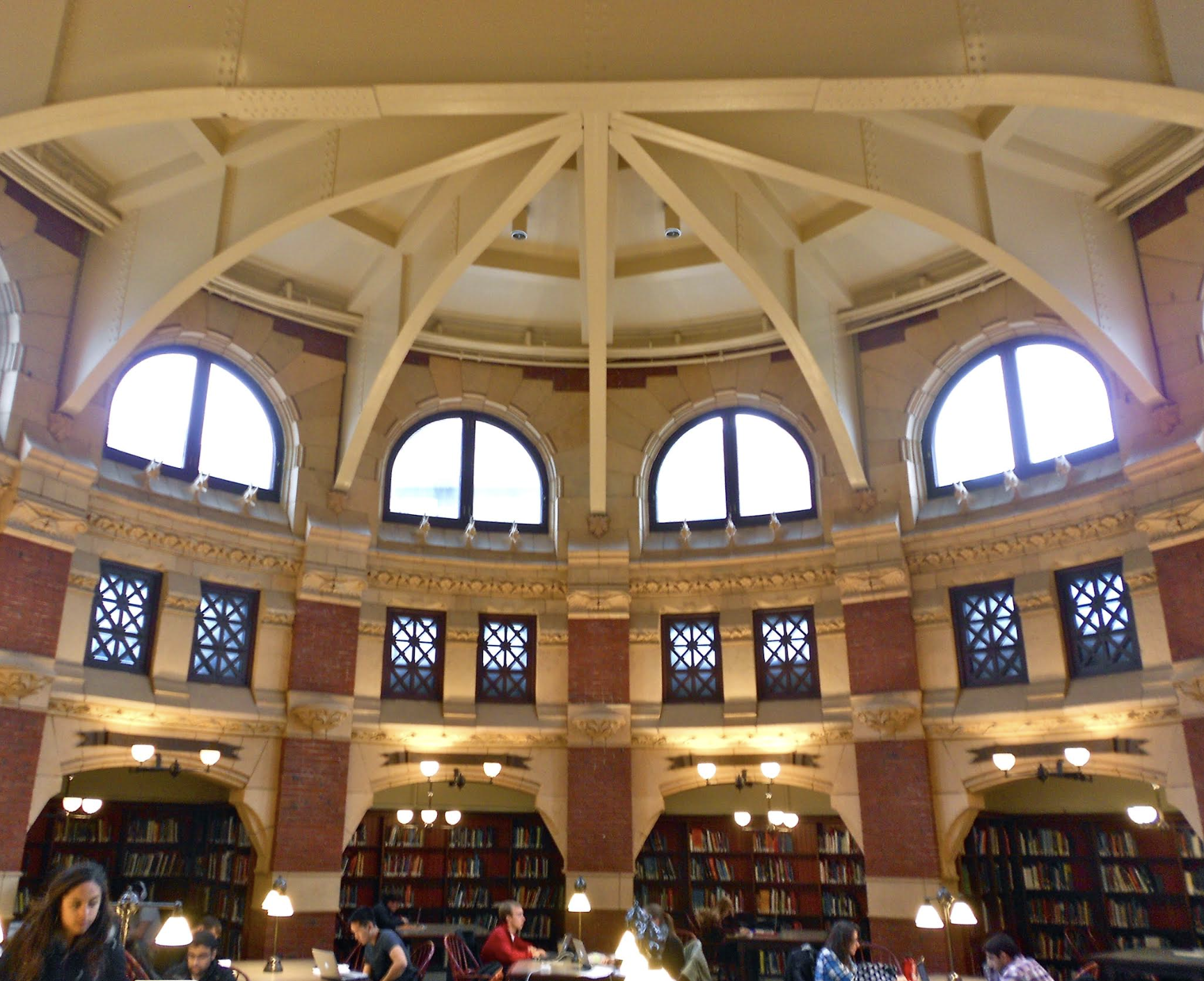
Consider Furness’s railroad stations, banks, and libraries. They are tough, confident, and industrial in character — unapologetically American in their directness. They do not ask to be loved. They ask to be taken seriously.
Do we need to love a building to learn from it?
WHAT CAN SARA ARCHITECTS TAKE FROM FURNESS TODAY?
Frank Furness’s life and work raise questions that remain relevant in 2026. They do not offer simple answers, but they are worth asking on the 250th anniversary of a nation founded on ideas of freedom and independence.
Most importantly, can architects help Americans see their country more clearly through the buildings and spaces we create? That is the spirit in which this series begins — extending the idea of “Architect Helping Architect” outward to the communities we shape.
AN INVITATION
As we celebrate America’s 250th, perhaps the most fitting tribute is not to declare what American architecture is or should be, but to keep asking what it might yet become. Furness does not offer a specific design direction for our time. Instead, his example — an American architect who brought courage, independence, and a deep engagement with precedent to his work — leaves us with an invitation.
What does it mean to you to be an American architect?
COMMENTS WELCOME!

Maria Lowndes Sevely, ASSOC. SARA
Maria is a New York–based architectural practitioner whose career includes substantial work as a designer and project manager on AIA National Honor Award–winning projects with three leading architectural firms—Pei Cobb Freed & Partners, Richard Meier & Partners, and the office of Philip Johnson—often collaborating directly with the founding principals. She served as senior project designer on the U.S. Holocaust Memorial Museum and later led multidisciplinary teams for NYC and New York State’s Hurricane Sandy recovery programs (Build It Back and GOSR), advancing community‐focused resiliency, primarily for homeowners. Maria studied architecture and architectural history at Wellesley and Harvard, continuing in a lineage of architects and educators. Having contributed to several architectural publications over the course of her career, she is pleased to launch the SARA Architect Perspectives series, exploring the intersections of American history, architecture, and civic identity through SARA member view points and forthcoming interviews.